

How to Choose the Right Label Material for Different Product Packaging Surfaces
Choosing the right label materials for packaging is an important part of creating reliable, attractive, and functional product packaging. A label does more than display your brand name. It communicates product information, supports brand identity, and helps customers recognize your products.
However, not every label material performs equally on every packaging surface. A label that works well on a glass bottle may not deliver the same results on a squeezable plastic container or a textured cardboard box.
Understanding the differences between packaging materials, adhesives, and environmental conditions can help businesses make better labeling decisions. Selecting suitable label materials for packaging also helps maintain product quality, improve brand presentation, and ensure reliable label performance.
In this guide, we’ll explore the most common label materials, their applications, and the factors to consider before choosing labels for your products.
Why Choosing the Right Label Material Matters
Product labels are exposed to different conditions throughout their lifecycle. Some products remain on dry retail shelves, while others experience refrigeration, moisture, transportation, frequent handling, or temperature changes.
Selecting an unsuitable label material can lead to peeling edges, wrinkles, fading, or poor adhesion.
The right label material helps businesses:
- Maintain consistent product presentation.
- Improve label durability during storage and handling.
- Support clear printing of product information and barcodes.
- Reduce labeling defects and unnecessary material waste.
- Create a professional appearance across packaging formats.
A well-matched label combines the right face material, adhesive, finish, and application method. Businesses can also explore self-adhesive labels for different packaging requirements.
Understanding Different Types of Label Materials for Packaging
Before selecting labels for a particular surface, it helps to understand the materials commonly used in packaging.
1. Paper Labels
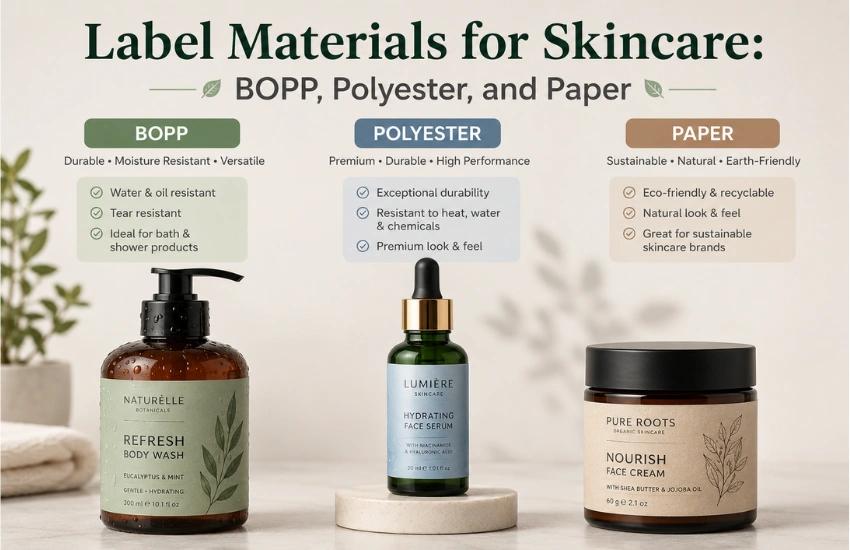
Paper labels are widely used for products stored in relatively dry environments. They offer good print quality and can be produced with different textures and finishes.
Common applications: Food cartons, retail boxes, promotional packaging, and dry consumer goods.
Paper labels can be an economical choice, but untreated paper may not perform well when exposed to moisture or repeated abrasion.
2. BOPP Labels
Biaxially Oriented Polypropylene (BOPP) is a popular film material used for packaging labels. It offers good moisture resistance and is available in white, clear, and metallic-looking options.
Common applications: Personal care bottles, food containers, beverage packaging, and household products.
BOPP labels are often selected when brands need a durable appearance with high-quality printed graphics.
3. PET Labels
Polyethylene Terephthalate (PET), also called polyester, is known for its dimensional stability and durability.
Common applications: Industrial containers, electronics, equipment identification, and products requiring long-lasting labels.
PET can be suitable where resistance to abrasion, temperature variation, or certain chemicals is important, depending on the specific construction.
4. Polyethylene Labels
Polyethylene (PE) films offer flexibility, making them useful for packaging that bends or changes shape during use.
Common applications: Squeezable bottles, flexible containers, and certain personal care products.
Their flexibility helps reduce the risk of wrinkling when the packaging is compressed.
For additional technical information, explore this pressure-sensitive labeling guide from Avery Dennison.
Choosing Label Materials for Different Packaging Surfaces
Different packaging surfaces require different approaches to label selection. Choosing the right label materials for packaging is particularly important because different substrates have different surface properties and adhesive requirements.
Labels for Plastic Bottles and Containers
Plastic packaging is widely used in cosmetics, food, healthcare, and household products.
However, plastics such as PET, HDPE, and PP have different surface properties. Some have relatively low surface energy, which can make adhesive selection more challenging.
BOPP and PE labels are common options, depending on the container’s shape and flexibility.
For squeezable bottles, a flexible film with a compatible adhesive is generally preferable to a rigid label construction.
Labels for Glass Bottles and Jars
Glass offers a smooth, rigid surface that can support attractive product labeling.
Paper, BOPP, and PET labels may all be suitable, depending on the product’s storage conditions and desired appearance.
For example, a dry food jar may work well with a paper label, while a refrigerated beverage bottle may benefit from a moisture-resistant film and adhesive.
Transparent labels can also create a clean, premium appearance on glass packaging.
Labels for Metal Containers
Metal tins, cans, and industrial containers may experience abrasion, temperature changes, or contact with oils and other substances.
PET and selected BOPP constructions can be suitable choices, depending on the application.
When selecting labels for metal packaging, consider the container’s coating, surface finish, curvature, and exposure conditions.
Labels for Cardboard Boxes and Paper Packaging
Cardboard and corrugated packaging can have textured or porous surfaces.
Paper labels are commonly used for product identification, shipping, and retail packaging. Film labels may also be appropriate where additional durability is required.
Adhesive performance is especially important on rough or recycled cardboard surfaces.
Labels for Flexible Pouches
Flexible pouches can bend, stretch, or change shape during filling, transportation, and handling.
Where pressure-sensitive labels are used, flexible PE or suitable PP films may offer better conformability.
The label construction should be tested to ensure it remains attached without lifting or wrinkling.
For specialised packaging applications, businesses can also explore shrink sleeve labels and In-Mold Labels (IML).
Key Factors to Consider Before Selecting Packaging Labels
Choosing the right material involves more than matching a label to a container.
- Surface compatibility: Check whether the packaging is smooth, rough, curved, rigid, or flexible.
- Adhesive performance: Choose an adhesive suitable for the packaging substrate, application temperature, and expected storage conditions.
- Moisture and temperature: Consider refrigeration, condensation, humidity, heat, and other environmental exposure.
- Print quality: Ensure the material supports readable text, accurate branding, and reliable barcode scanning.
- Finish and appearance: Glossy, matte, white, and transparent finishes can create different visual effects.
- Budget and lifecycle: Evaluate material costs alongside durability, application efficiency, and expected product shelf life.
These factors should be considered together rather than independently.
Why Label Testing Is Important Before Bulk Production
Even when a material appears suitable, real-world performance can vary.
Before confirming a large production order, businesses should test sample labels on their actual packaging.
Check adhesion, edge lifting, print durability, and appearance after exposure to expected storage and handling conditions.
Testing is particularly important for curved containers, low-surface-energy plastics, refrigerated products, and packaging exposed to chemicals.
A small amount of testing early in the process can help prevent larger packaging problems later.
Frequently Asked Questions About Label Materials for Packaging
1. What are the most commonly used label materials for packaging?
The most commonly used label materials for packaging include paper, BOPP, PET, and PE. Each material offers different benefits depending on the packaging surface, moisture exposure, durability requirements, and product application.
2. Which label material is best for plastic bottles?
BOPP and PE are commonly used for plastic bottle labels. BOPP offers good moisture resistance, while flexible PE labels are suitable for squeezable containers. The final choice depends on the plastic type, bottle shape, and adhesive compatibility.
3. Are BOPP labels waterproof?
BOPP film offers good resistance to moisture and is commonly used for beverage, food, and personal care packaging. However, overall water resistance also depends on the adhesive, printing inks, and protective coating or lamination.
4. What is the difference between paper labels and film labels?
Paper labels are generally suitable for dry applications and offer excellent print quality. Film labels, such as BOPP, PET, and PE, provide better flexibility or moisture resistance depending on their construction and are often preferred for demanding packaging environments.
5. Which label material is suitable for refrigerated products?
BOPP and other suitable synthetic film labels can be used for refrigerated products. However, selecting a compatible moisture-resistant adhesive is equally important to prevent peeling caused by condensation and temperature changes.
6. Can labels be customised for different packaging surfaces?
Yes. Labels can be customised based on packaging material, shape, size, printing requirements, adhesive type, and finish. Proper material selection and application testing help ensure suitable performance.
7. How do I choose the right adhesive for packaging labels?
Consider the packaging surface, application temperature, storage environment, and product usage. Smooth plastics, glass, metal, and textured cardboard may require different adhesive formulations to achieve reliable bonding.
8. Where can I get customised packaging labels?
You can contact Ugar Labels for customised self-adhesive labels and packaging solutions. Share your product details, packaging surface, quantity, and application requirements to discuss suitable material options.
Choose Reliable Labeling Solutions with Ugar Labels
At Ugar Labels, we understand that effective product labeling requires careful consideration of packaging surfaces, materials, adhesives, and printing requirements.
Whether your business needs labels for bottles, containers, cartons, or specialised packaging, selecting the appropriate construction is essential for consistent results.
Our team can discuss your packaging requirements and help you explore suitable labeling options based on your application.
Looking for the right labels for your product packaging?
Explore our label printing services or contact our team to discuss your requirements.
Conclusion
Choosing the right label materials for packaging helps protect product presentation, improve durability, and maintain consistent branding.
Paper, BOPP, PET, and PE each offer different advantages. The best choice depends on the packaging surface, environmental conditions, adhesive compatibility, and desired finish.
By understanding these factors and testing labels before production, businesses can make more informed decisions and achieve reliable packaging results.
