

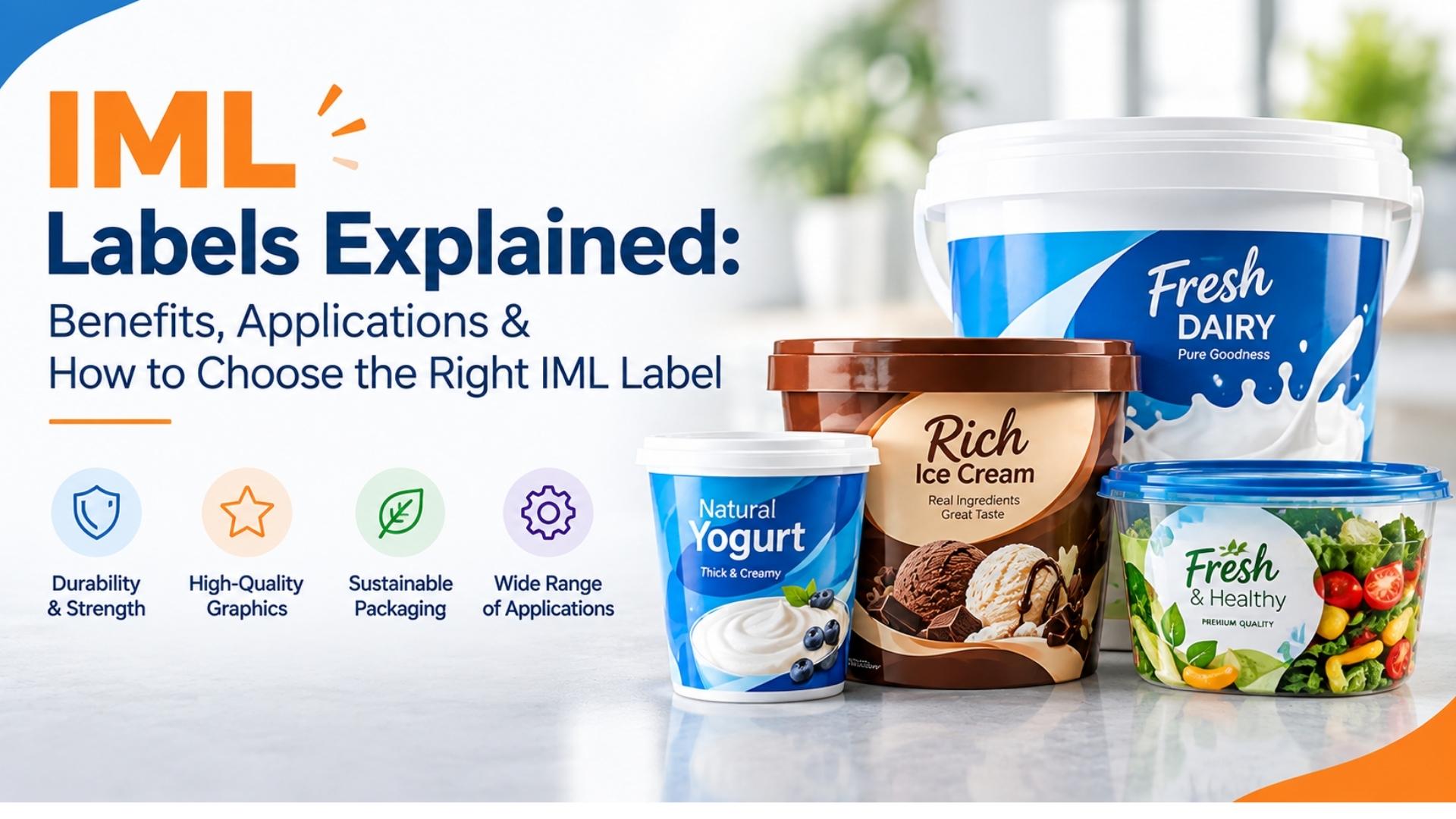
IML Labels Explained: Benefits, Applications & How to Choose the Right IML Label
Packaging plays a critical role in protecting products, communicating brand information, and creating a strong presence on retail shelves. As packaging technology continues to evolve, brands are increasingly looking for solutions that combine visual appeal, durability, production efficiency, and consistent quality.
IML labels, or In-Mold Labels, are an advanced labeling solution designed to integrate labeling with the molding process. They are widely used for packaging applications that require high-quality graphics, durable decoration, and a clean, integrated appearance.
But what exactly are IML labels? How does in-mold labeling work, and what should businesses consider when selecting the right IML solution?
This guide explains the fundamentals of IML, its key benefits, common applications, and the factors to consider when choosing an IML label supplier.
What Are IML Labels?
IML stands for In-Mold Labeling. Unlike conventional labels that are applied to a finished container, an IML label is placed inside the mold before the container is formed.
During the molding process, the label becomes integrated with the surface of the finished packaging. This creates a seamless appearance and eliminates the need for a separate post-molding labeling operation in suitable applications.
In-mold labels are manufactured using materials designed to work effectively with specific molding processes and packaging substrates. The final result is a label that becomes an integral part of the package rather than a separate adhesive label.
How Does In-Mold Labeling Work?
The exact process varies depending on the packaging format, material, and molding technology. However, the basic principle remains the same.
First, the label artwork is printed on a suitable substrate. The printed label is then accurately positioned inside the mold.
The packaging material is subsequently introduced into the mold. During the molding process, the label integrates with the surface of the container.
Once molding is complete, the finished package emerges with the decoration already incorporated into its surface.
This approach combines packaging production and labeling into a coordinated manufacturing process.
Key Benefits of IML Labels
1. High-Quality Printing and Graphics
A major advantage of IML is the ability to achieve high-quality, detailed graphics.
Modern IML printing can support detailed artwork, brand colours, product information, regulatory information, and other design elements.
This gives brands greater flexibility when creating packaging that needs to stand out on retail shelves.
Consistent colour reproduction and accurate printing are particularly important for brands with strict visual identity guidelines.
2. Integrated and Consistent Appearance
Because the label is incorporated during the molding process, it becomes an integrated part of the packaging.
This can create a clean and uniform appearance without the visible edges or application characteristics associated with some conventional adhesive labels.
For brands focused on premium presentation and consistent packaging aesthetics, this can be an important advantage.
3. Evaluate Printing Requirements
Consider the required level of graphic detail, number of colours, brand guidelines, barcode requirements, product information, and other artwork specifications.
High-quality IML printing can help maintain visual consistency across large production volumes.
4. Review Container Shape and Label Positioning
Container geometry can have a significant influence on label design and positioning.
Artwork should be prepared using accurate dimensions and appropriate templates. The design should also account for the final label position and the requirements of the molding process.
5. Consider Production Volume
Production volume is an important factor when evaluating IML.
For high-volume molded packaging applications, IML can provide significant production benefits when the appropriate equipment, tooling, and process infrastructure are available.
For smaller or frequently changing production requirements, alternative labeling technologies may sometimes be more practical.
6. Evaluate Supplier Capability
The right supplier should offer more than printing capacity.
When evaluating in mold label manufacturers, consider:
- Printing capabilities
- Material expertise
- Quality-control procedures
- Production capacity
- Technical support
- Artwork and pre-press assistance
- Consistency between production batches
- Delivery reliability
A supplier with strong technical capabilities can help identify potential issues before they affect production.
Questions to Ask an IML Label Supplier
Before selecting an IML supplier, ask the following questions:
- Which IML materials and substrates do you offer?
- Which molding processes do you support?
- Can you provide samples using our actual packaging format?
- What printing technologies are available?
- How do you control colour and print consistency?
- Can you support custom container shapes and designs?
- What quality-control procedures are followed?
- What production volumes can you accommodate?
- Do you provide artwork and pre-press support?
- What are your typical production lead times?
These questions can help businesses compare suppliers based on technical capability, quality, reliability, and long-term support rather than price alone.
Conclusion
IML labels provide an integrated approach to packaging decoration by combining labeling with the molding process. For suitable applications, they can offer high-quality graphics, consistent appearance, durability, extensive branding space, and efficient production.
However, selecting the right IML solution requires more than choosing an attractive label design. Businesses should evaluate the packaging material, container geometry, molding technology, production volume, printing requirements, quality expectations, and supplier capabilities.
Whether you are considering IML printing, in-mold labels, or complete in-mold packaging labels, the right solution should be selected according to the specific requirements of your product and production process.
Working with an experienced supplier can simplify the process by providing support across material selection, artwork preparation, printing, quality control, and production.
Ultimately, the right IML label is not simply about creating attractive packaging. It is about achieving the right balance of appearance, performance, manufacturing compatibility, consistency, and overall packaging value.
For more insights into the Indian label and packaging industry, read about Ugar Labels’ growth and packaging innovations.
