

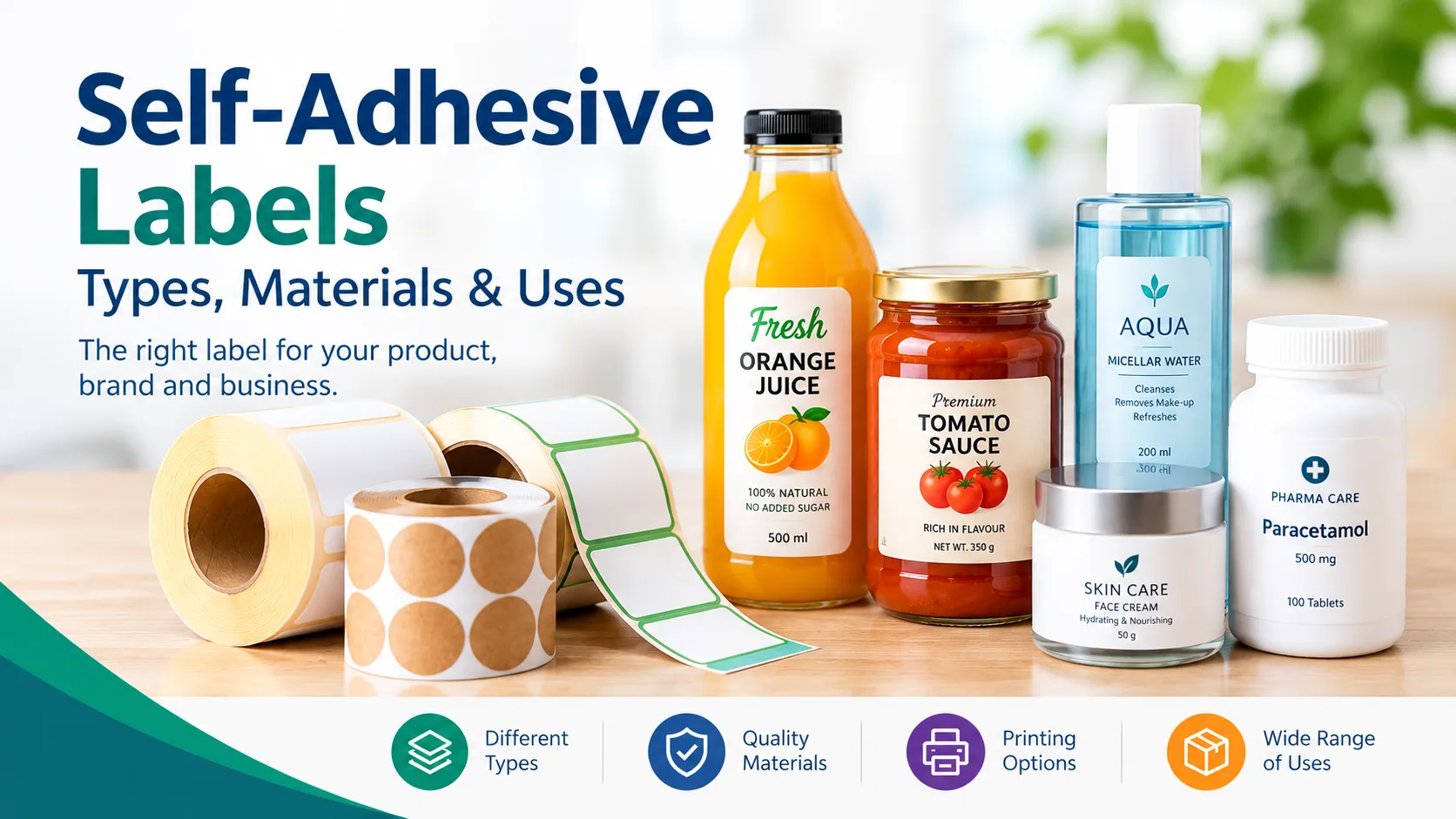
Self-Adhesive Labels: Types, Materials, Applications & How to Choose the Right Label
A product label is often the first thing customers notice on a package. It tells them what the product is, who made it,
how to use it, and sometimes even what makes it different from competing products. This is where
self-adhesive labels play an important role. From food jars and beverage bottles to cosmetic
containers, pharmaceutical packaging, and industrial products, these labels are used across a wide range of industries.
Their popularity comes from their simplicity. They can be printed with detailed designs, supplied in convenient rolls,
and applied directly to packaging without requiring a separate adhesive application process. But choosing the right
label is not simply about selecting a good-looking design. The material, adhesive, packaging surface, printing method,
and environment all need to work together.
What Are Self-Adhesive Labels?
Self-adhesive labels are labels that have an adhesive layer on the back, allowing them to stick
directly to a product or packaging surface. They are also commonly called adhesive labels or
pressure-sensitive labels because the adhesive bonds to the surface when pressure is applied. A typical
self-adhesive label has three basic layers:
- Face material: The visible surface where the design, text, barcode, or product information is
printed. - Adhesive: The layer that helps the label bond to the packaging.
- Release liner: The backing sheet that protects the adhesive until the label is ready to be
applied.
This simple construction makes self-adhesive labels suitable for everything from everyday product packaging to more
demanding industrial applications.
Types of Self-Adhesive Labels
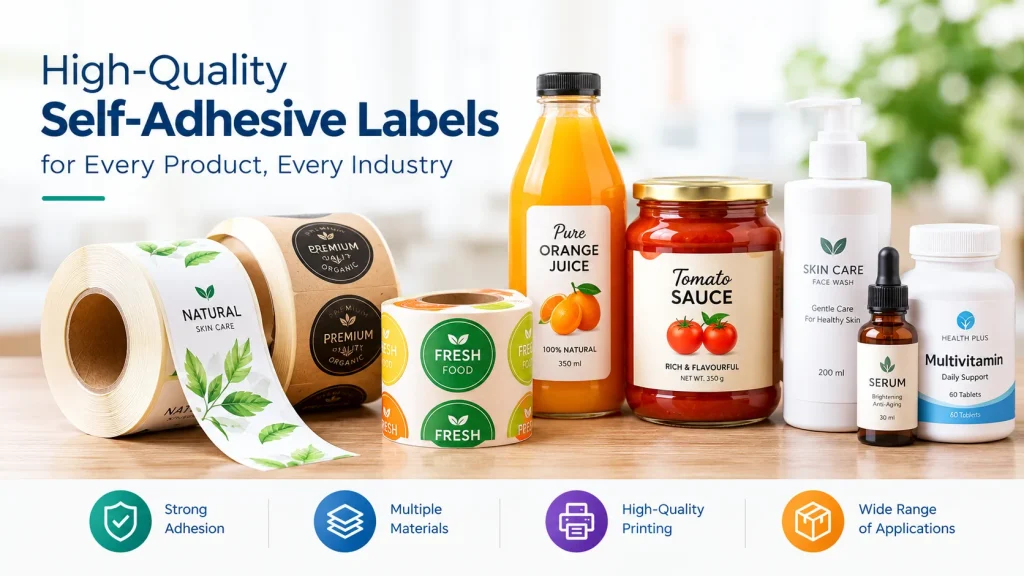
Not every product needs the same type of label. The right choice depends on the packaging, application, environment, and
desired appearance.
1. Paper Self-Adhesive Labels
Paper labels are one of the most commonly used options. They offer good print quality and are generally economical,
making them suitable for many everyday packaging and labeling applications. They are commonly used for food packaging,
retail products, promotional labels, and products stored in relatively controlled environments.
2. Film-Based Labels
Film materials such as BOPP, PET, and PE are often selected when better moisture resistance, durability, or flexibility
is required. For example, BOPP labels are widely used on food, beverage, personal care, and household products because
they can provide a clean appearance while handling exposure to moisture better than many paper labels.
3. Clear Self-Adhesive Labels
Clear labels are a popular choice when brands want a clean, premium, or “no-label” appearance. They work particularly
well on transparent packaging where the product itself is intended to remain visible. They are commonly seen on
beverages, cosmetics, personal care products, and premium packaging.
4. Permanent Adhesive Labels
Permanent adhesive labels are designed for applications where the label needs to remain firmly attached throughout the
expected life of the product. They are commonly used for product identification, packaging, industrial products, and
applications where removing the label is not normally required.
5. Removable Adhesive Labels
As the name suggests, removable labels are designed for applications where the label may need to be removed later. They
can be useful for temporary promotions, retail applications, reusable containers, or situations where product
information may need to be changed.
Common Materials Used for Adhesive Labels
The material you choose can have a major impact on how the finished label looks and performs.
Paper
Paper is a practical choice for many general-purpose applications. It offers good printability and is available in
different finishes, including matte and gloss.
BOPP
BOPP, or biaxially oriented polypropylene, is widely used for packaging labels. It offers good moisture resistance,
durability, and attractive print results.
PET
PET is known for its strength, dimensional stability, and durability. It can be a suitable option for labels exposed to
moisture, abrasion, chemicals, or more demanding conditions.
PE
PE, or polyethylene, is a flexible material that can work well on squeezable containers and curved surfaces where
flexibility is important.
Where Are Self Adhesive Labels Used?
One of the biggest advantages of self adhesive labels is their versatility. They are used across many
industries and applications.
Food & Beverage
Jars, bottles, containers, sauces, beverages, dairy products, and other packaged foods commonly use adhesive labels for
branding and product information. Depending on the application, moisture resistance and suitable adhesive performance
may be important considerations.
Pharmaceuticals
Pharmaceutical labels carry important information such as product names, batch numbers, expiry dates, dosage
instructions, and regulatory details. Accuracy and consistency are particularly important in this sector.
Cosmetics & Personal Care
For cosmetics and personal care products, the label is part of the overall product experience. Premium materials,
high-quality printing, special finishes, and attractive designs can help create a stronger shelf presence.
Chemicals & Industrial Products
Industrial products may face more demanding conditions, including exposure to chemicals, oils, temperature changes,
abrasion, or outdoor environments. In such cases, a durable face material and application-appropriate adhesive become
especially important.
Retail & Logistics
Roll labels are widely used for barcodes, pricing, inventory identification, shipping information, and
product tracking. For businesses using automatic labeling machines, consistent roll quality and accurate label
dimensions are particularly important.
Self-Adhesive Labels vs. Pressure Sensitive Labels
You may come across both the terms self-adhesive labels and
pressure sensitive labels when researching labeling solutions. In many cases, they refer to essentially
the same type of labeling technology: a label with an adhesive that bonds when pressure is applied. However, the
important factor is the complete label construction. The face material, adhesive, liner, printing, and finishing should
all be selected based on how and where the label will be used.
How to Choose the Right Self Adhesive Labels
Choosing the right label becomes much easier when you start with the application rather than the design.
1. Look at the Packaging Surface
First, consider what the label will be applied to. Glass, PET, HDPE, metal, cardboard, and flexible packaging can all
behave differently. The shape and texture of the surface also matter, especially when labeling curved or squeezable
containers.
2. Think About the Environment
Ask where the product will be stored and used. Will the label be exposed to:
- Water or condensation?
- Refrigeration or freezing?
- Heat?
- Sunlight or UV exposure?
- Chemicals or oils?
- Frequent handling or abrasion?
The answers will help determine the right material and adhesive.
3. Choose the Right Adhesive
Adhesive selection is one of the most important parts of label specification. A permanent adhesive may be suitable for
long-term product identification, while a removable adhesive may be better for temporary applications. The application
temperature, surface type, required bond strength, and expected product life should all be considered.
4. Consider the Printing Requirements
Your label needs to look good, but it also needs to remain readable throughout its intended life. Depending on the
application, labels can be produced using different printing technologies, including digital and flexographic printing.
The desired finish—such as matte, gloss, varnish, or lamination—can also influence the final appearance and durability.
5. Get the Size and Shape Right
A label should fit the packaging properly without interfering with important product information or application
equipment.
Custom labels can be produced in different shapes and sizes, allowing brands to create packaging that
matches their product design and positioning.
6. Consider How the Labels Will Be Applied
There is a big difference between applying labels by hand and using an automatic labeling machine. For automated
applications, factors such as roll direction, label spacing, liner performance, dimensions, and consistency become very
important. A label that looks perfect but does not run smoothly through the application machine can create unnecessary
production delays.
Why Choosing the Right Label Manufacturer Matters
The quality of a label depends on both the materials used and the manufacturing process.
When choosing self-adhesive label manufacturers, look for a supplier that understands your specific packaging and labeling requirements.
For more information about Ugar Labels and its growth in the label printing industry, read this feature from Packaging South Asia: Ugar Labels’ Growth in the Label Printing Industry.
A reliable manufacturer should be able to help with:
- Material and adhesive selection
- Printing and color consistency
- Custom label sizes and shapes
- Roll specifications
- Artwork and prepress requirements
- Quality control
- Sampling and testing
- Production capacity
- Application-specific recommendations
For demanding applications, testing samples before moving into full-scale production can help identify potential issues
with adhesion, printing, or machine application.
How Custom Labels Can Strengthen Your Brand
A label does more than provide information. It is also an important part of your brand identity. The right combination
of material, color, typography, finish, shape, and printing quality can make a product look more premium and
recognizable. This is particularly important in competitive retail categories, where customers may see several similar
products on the same shelf. A well-designed custom label can help communicate the product’s positioning
while maintaining consistency across an entire product range.
Conclusion
Self-adhesive labels may look simple, but there is a lot that goes into choosing the right one. The
best label is not necessarily the most expensive or visually impressive option. It is the one that performs reliably in
the environment where it will be used while delivering the appearance, information, and branding the product needs.
Before making a decision, consider the packaging surface, environmental conditions, adhesive type, label material,
printing requirements, application method, and expected product life. And if you are unsure which combination is right,
working with an experienced label manufacturer can save time, reduce production issues, and help you arrive at a
solution that balances quality, performance, appearance, and cost.
Frequently Asked Questions
What are self-adhesive labels used for?
Self-adhesive labels are used for product packaging, branding, identification, barcoding, retail, logistics,
pharmaceuticals, food and beverage, cosmetics, and industrial applications.
Are self-adhesive labels waterproof?
Not all self-adhesive labels are waterproof. Water and moisture resistance depend on the face material, adhesive,
printing method, and overall label construction. Film-based materials such as BOPP and PET are often considered when
greater moisture resistance is required.
What is the difference between adhesive labels and pressure-sensitive labels?
The terms are often used interchangeably for labels that use pressure-sensitive adhesive technology. However, the exact
construction can vary depending on the application and performance requirements.
Can self-adhesive labels be customized?
Yes. Custom labels can be produced in different materials, shapes, sizes, finishes, adhesive types, and
printing specifications to suit specific products and packaging designs.
How do I choose the right self-adhesive label?
Start by looking at the packaging surface, environmental conditions, required durability, adhesive requirements,
printing method, application process, and expected product life. These factors will help determine the most suitable
label construction.
