



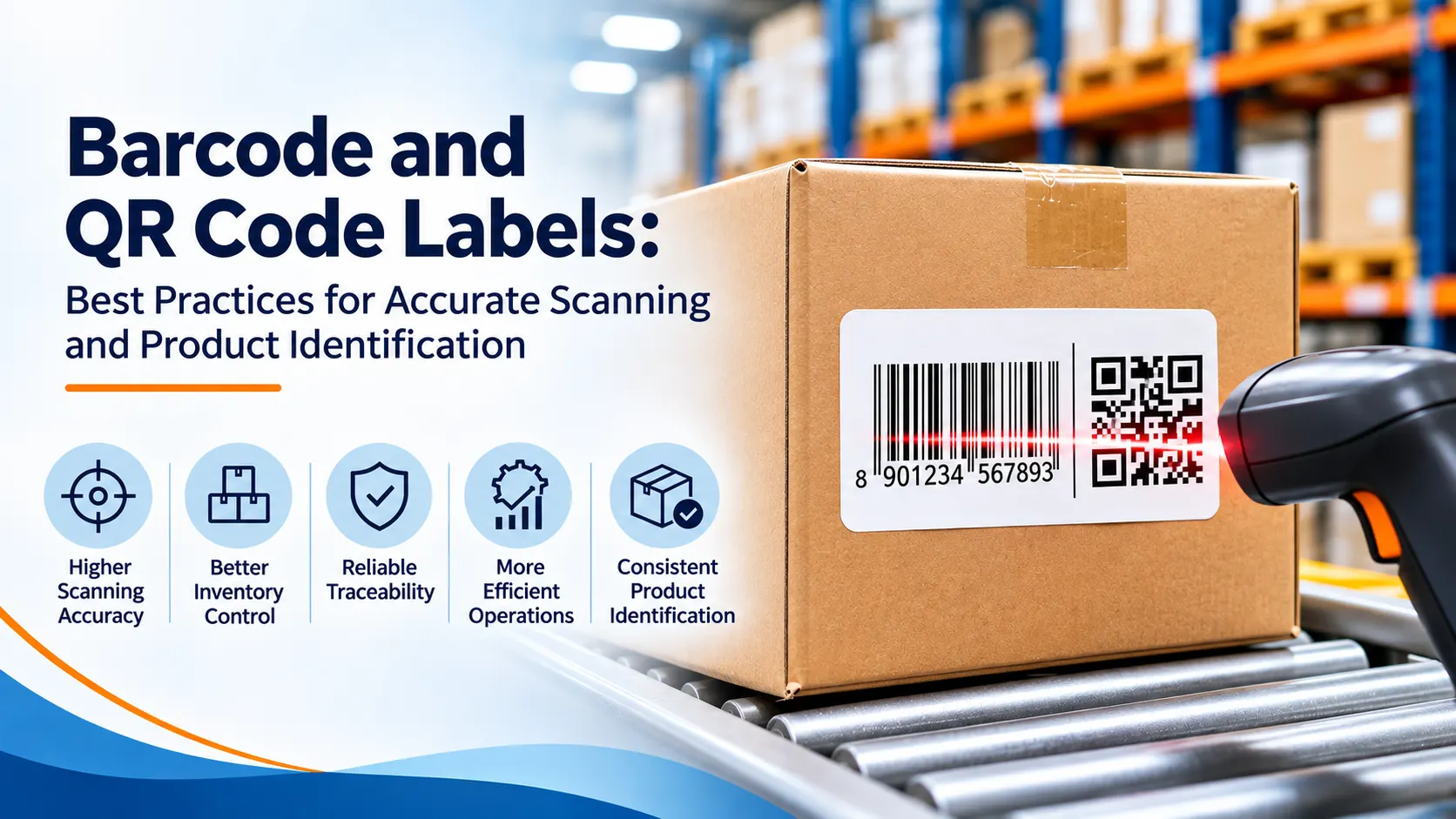
Barcode and QR Code Labels: Best Practices for Accurate Scanning and Product Identification
In today’s fast-moving manufacturing and supply chain environment, accurate product identification is essential. From production lines to warehouse shelves and retail counters, businesses depend on reliable labeling systems to track products and manage information efficiently.
Barcode and QR code labels make this process faster and more organized. They allow businesses to identify products, access information, and reduce errors caused by manual data entry.
However, a poorly printed barcode, unsuitable label material, or incorrect placement can create scanning difficulties and disrupt daily operations. Choosing the right barcode and QR code labels helps businesses maintain product identification accuracy and improve operational efficiency.
Understanding the best practices for designing, printing, and applying these labels can help businesses improve scanning accuracy and maintain consistent product identification.
What Are Barcode and QR Code Labels?
Barcode and QR code labels are printed identification labels that contain machine-readable information.
A traditional barcode typically uses parallel lines and spaces to represent encoded data. These labels are commonly used for product identification, inventory management, retail billing, and logistics operations.
A QR code is a two-dimensional code containing a pattern of black and white modules. It can encode more information than many traditional linear barcodes, including website links, product identifiers, and other structured data.
Both technologies support product identification, but their suitability depends on the intended application, scanning equipment, and information requirements.
Why Accurate Barcode and QR Code Scanning Matters
Reliable scanning is important throughout the product lifecycle.
When barcode labels are difficult to read, employees may need to scan products repeatedly or enter information manually. This can slow operations and increase the possibility of errors.
Well-designed barcode and QR code labels help businesses achieve several benefits:
- Faster product identification: Reduce the time required to identify and process items.
- Improved inventory accuracy: Support reliable stock movement and record management.
- Better traceability: Connect products with relevant batch, shipment, or production information.
- Reduced manual errors: Minimize unnecessary data entry during routine operations.
- Efficient logistics: Support receiving, sorting, dispatch, and distribution activities.
Consistent label quality helps maintain dependable scanning performance across different operational environments.
Best Practices for Barcode and QR Code Labels
1. Choose the Right Label Material
The material used for a barcode label directly affects its durability and readability.
Paper labels are often suitable for dry, indoor applications, while synthetic materials such as polypropylene (BOPP) and polyester (PET) can provide additional resistance to moisture and handling.
For industrial environments, label materials should be selected according to temperature, abrasion, chemical exposure, and expected service life.
Choosing the correct material helps prevent damage that could interfere with scanning. Explore our label printing and packaging solutions for different product requirements.
2. Maintain High Print Quality
Clear printing is one of the most important requirements for accurate scanning.
Barcode lines and QR code modules must be reproduced with sufficient sharpness and contrast.
Poor print quality can result in blurred edges, missing elements, inconsistent spacing, or unreadable codes.
Use suitable printing equipment, compatible materials, and appropriate print settings to maintain consistent results.
3. Use the Correct Barcode Size and Quiet Zone
Every barcode and QR code requires sufficient space for reliable scanning.
A quiet zone is the clear area surrounding a code that helps scanning devices distinguish it from nearby graphics or text.
Reducing the quiet zone or printing the code too small may cause scanning failures.
The required dimensions depend on the barcode symbology, applicable standards, printer capability, and scanning environment.
For additional guidance, refer to the GS1 India barcode verification guidelines.
4. Ensure Proper Label Placement
Even a perfectly printed barcode can become difficult to scan when placed incorrectly.
Avoid positioning codes across folds, seams, sharp curves, or heavily textured areas.
On cylindrical packaging, consider how surface curvature affects the scanner’s ability to read the code.
For cartons and shipping packages, place labels where they remain visible and accessible during handling.
5. Select the Right Adhesive
A label must remain securely attached throughout its intended lifecycle.
Different packaging surfaces, including cardboard, glass, plastic, and metal, may require different adhesive formulations.
The adhesive should be compatible with the surface material, application temperature, storage conditions, and expected handling.
Poor adhesion can cause labels to peel, wrinkle, or detach, affecting product identification.
6. Test Barcode Scanning Before Production
Testing should be completed before large-scale label printing.
Scan sample labels using the equipment and conditions expected during actual operations.
Check readability at typical scanning distances and after relevant environmental exposure.
For applications requiring formal barcode quality assessment, use appropriate verification equipment and applicable ISO/IEC or GS1 specifications.
According to GS1 barcode quality guidance, a compliant barcode verifier can measure print quality and provide an overall quality grade.
Testing helps identify problems before labels reach production lines or customers.
Choosing Barcode Label Materials for Different Applications
The ideal material for barcode and QR code labels depends on how and where the label will be used.
| Application | Common Material Options |
|---|---|
| Retail product packaging | Paper, BOPP |
| Warehouse cartons | Paper, suitable synthetic films |
| Industrial equipment | PET, durable synthetic films |
| Food and beverage containers | BOPP, PET |
| Healthcare packaging | Application-specific paper or synthetic films |
| Outdoor product identification | Weather-resistant PET or other qualified films |
These are general material options. Final selection should be based on application testing and relevant industry requirements.
Common Barcode and QR Code Labeling Mistakes
Several avoidable mistakes can affect label performance.
- Low contrast: Decorative backgrounds or insufficient contrast can make codes difficult to read.
- Incorrect sizing: Codes printed below suitable dimensions may not scan reliably.
- Unsuitable materials: Labels may deteriorate when exposed to moisture, chemicals, or abrasion.
- Poor placement: Wrinkles, curves, and packaging seams can interfere with scanning.
- Missing verification: A code that scans once is not necessarily compliant with the required print-quality standard.
Addressing these issues during label design and production can reduce operational difficulties and improve product identification.
How Ugar Labels Supports Product Identification
At Ugar Labels, we recognize the importance of clear, consistent, and dependable product labeling.
Barcode and QR code labels must combine readable printing, suitable materials, compatible adhesives, and accurate variable information.
Whether your business requires labels for retail packaging, industrial products, inventory identification, or logistics applications, understanding the operating environment is essential.
Selecting the right label construction helps support reliable scanning and efficient product identification.
For labeling requirements and material discussions, explore our label and packaging solutions or connect with the Ugar Labels team.
Website: www.ugarlabels.com
Email: sales@ugarlabels.com
Phone: +91 93250 09520
Looking for reliable barcode and QR code labels for your products? Contact our team to discuss your labeling requirements.
Frequently Asked Questions About Barcode and QR Code Labels
1. What is the difference between barcode and QR code labels?
Traditional linear barcodes generally encode information in one dimension, while QR codes use a two-dimensional pattern that can store more data, including website links and product information.
2. Which material is best for barcode labels?
Paper is commonly used for dry indoor applications, while BOPP and PET can be suitable for applications requiring greater moisture resistance and durability. The best choice depends on the product and operating environment.
3. How can businesses improve barcode scanning accuracy?
Use clear printing, appropriate dimensions, sufficient quiet zones, suitable label materials, correct placement, and barcode quality verification to improve scanning accuracy.
4. Why is the quiet zone important in barcode printing?
The quiet zone is the clear space around a barcode or QR code. It helps scanning devices identify the code correctly. Printing text, graphics, or borders too close to the code can interfere with scanning.
5. Can QR codes be printed on product packaging labels?
Yes. QR codes can be printed on product packaging labels to provide access to websites, product details, instructions, traceability information, and other digital resources. The code should have sufficient size, contrast, and clear surrounding space.
6. What causes barcode scanning failures?
Common causes include low print contrast, blurred printing, incorrect sizing, insufficient quiet zones, damaged labels, unsuitable materials, and incorrect placement on packaging.
7. What is barcode verification?
Barcode verification is a quality assessment process that evaluates printed codes against relevant technical standards. It checks parameters such as symbol contrast, dimensions, defects, and quiet zones to determine print quality.
8. Where are barcode and QR code labels commonly used?
Barcode and QR code labels are commonly used in retail, manufacturing, warehousing, healthcare, food and beverage packaging, inventory management, and logistics operations.
Conclusion
Barcode and QR code labels play an important role in accurate product identification, inventory control, and supply chain efficiency.
Their performance depends on more than the printed code. Material selection, adhesive compatibility, print quality, placement, and verification all contribute to reliable scanning.
By following these best practices, businesses can reduce labeling problems, improve operational accuracy, and maintain consistent product identification across their packaging and distribution processes.
